


“The impediment to action advances action. What stands in the way becomes the way.”
This quote by famed Roman Emperor and Stoic Philosopher, Marcus Aurelius, perfectly encapsulates the motivations behind this fledgling publication.
The Patchwork 50 is a bi-weekly exercise in examining the shifting policy, regulatory and legal dynamics which shape the emerging industries of the 21st century.
At its core, this space is a compendium of knowledge-gathering within the policy and regulatory space of emerging markets and industries. The mission here is to identify the obstacles, map them and adapt to them. Within this corner of the internet we lean into the uncertainty, the long-game approach and the chaos of American public policy to overcome political and regulatory obstacles and successfully navigate the Patchwork.
The Patchwork 50 is a place not just to learn about the obstacle along the path, it’s an instruction manual to plan for it and ultimately to hedge for or against it—you decide.
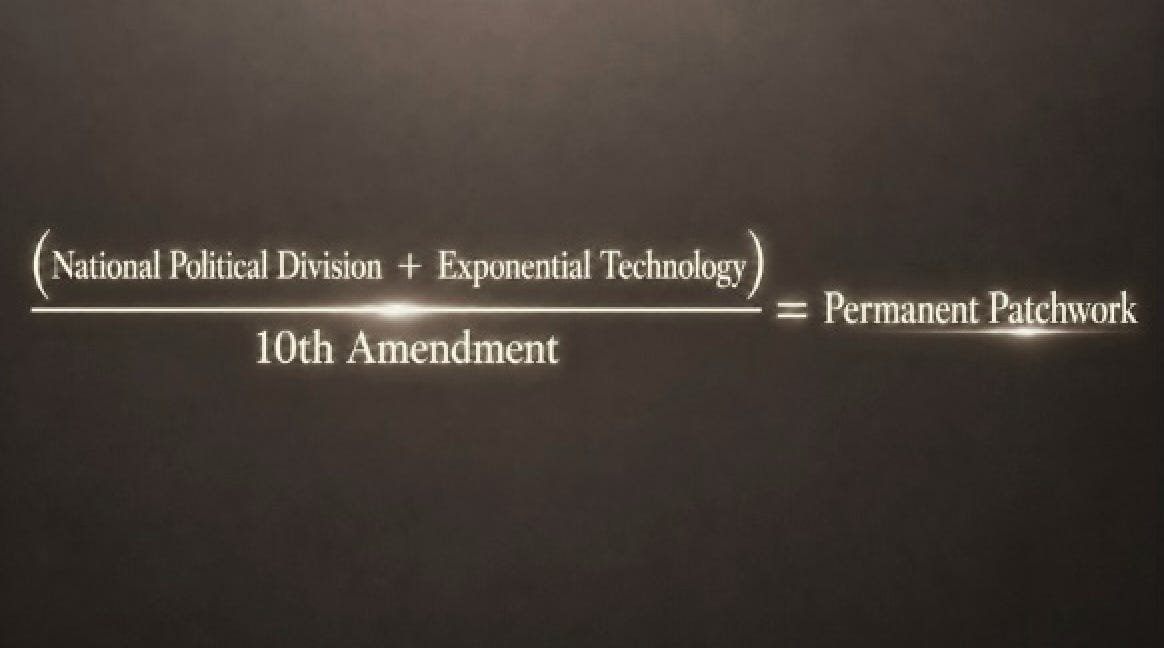
It’s a place which posits that the American political system is nothing more than a complex web of 50 separate rulebooks for any given issue, technology, product or industry — and that this web is navigable, if you possess the proper tools, knowledge and information.
The gap is structural, it’s widening with a politically volatile central government and fractured two-party rule — and it’s working, for better or worse, the way it was designed.
It’s striking how much we are aware of the dysfunction in government yet are continuously surprised by the lackluster outcomes it produces. What’s more striking is the tendency to which we refuse to acknowledge that this dysfunction is a feature built into the system itself, not a bug.
It’s an obvious observation that in this hyper-divided federal government, the states are reclaiming their legislative power to build, restructure and sometimes roll back huge advances in modern society. As we see the emerging technology and VC converge increasingly more in modern times, and as we see the Washington D.C. governing window continue to diminish and collapse upon itself, the states are filling the void. In doing so they are creating big opportunity for policy leaders, stakeholders and businesses of all kinds.
Given all of this, the goal here is to treat the obstacles of regulatory uncertainty and built-in fragmentation as the game itself, because it is.
I’m talking about putting in the work. The patchwork.
Who Sent Me?
Oftentimes in my political journey, I’ve heard something that translates to the effect of “Who sent you?” Given respect for this important question, I should tell you why I think I can be your messenger on this journey.
I’m a longtime government affairs and political professional who has spent their career advising clients in both the public and private sector. My current focus concerns the interconnected web of emerging technologies, capital flows and public policy shifts within both highly regulated and unregulated/under-regulated markets and industries. I’ve spent a career advising both large and small entities on how to navigate, prepare for and capitalize on the subtle shifts and positioning within the policy process, and the aim of this project is to help both public and private readers analyze this information, discover nuance and take meaningful actions for their shareholders, constituents or other clientele.
Practically, what this publication buys you is a look under the hood of government from both a former high-ranking staffer and now an outside consultant’s perspective; an outsider’s iteration on insider knowledge. This niche will provide you a peek into how the sausage gets cooked. You’ll learn which definition gets argued over, and which arguments to follow, because whoever writes the definition writes the market.
Fifty Rulebooks
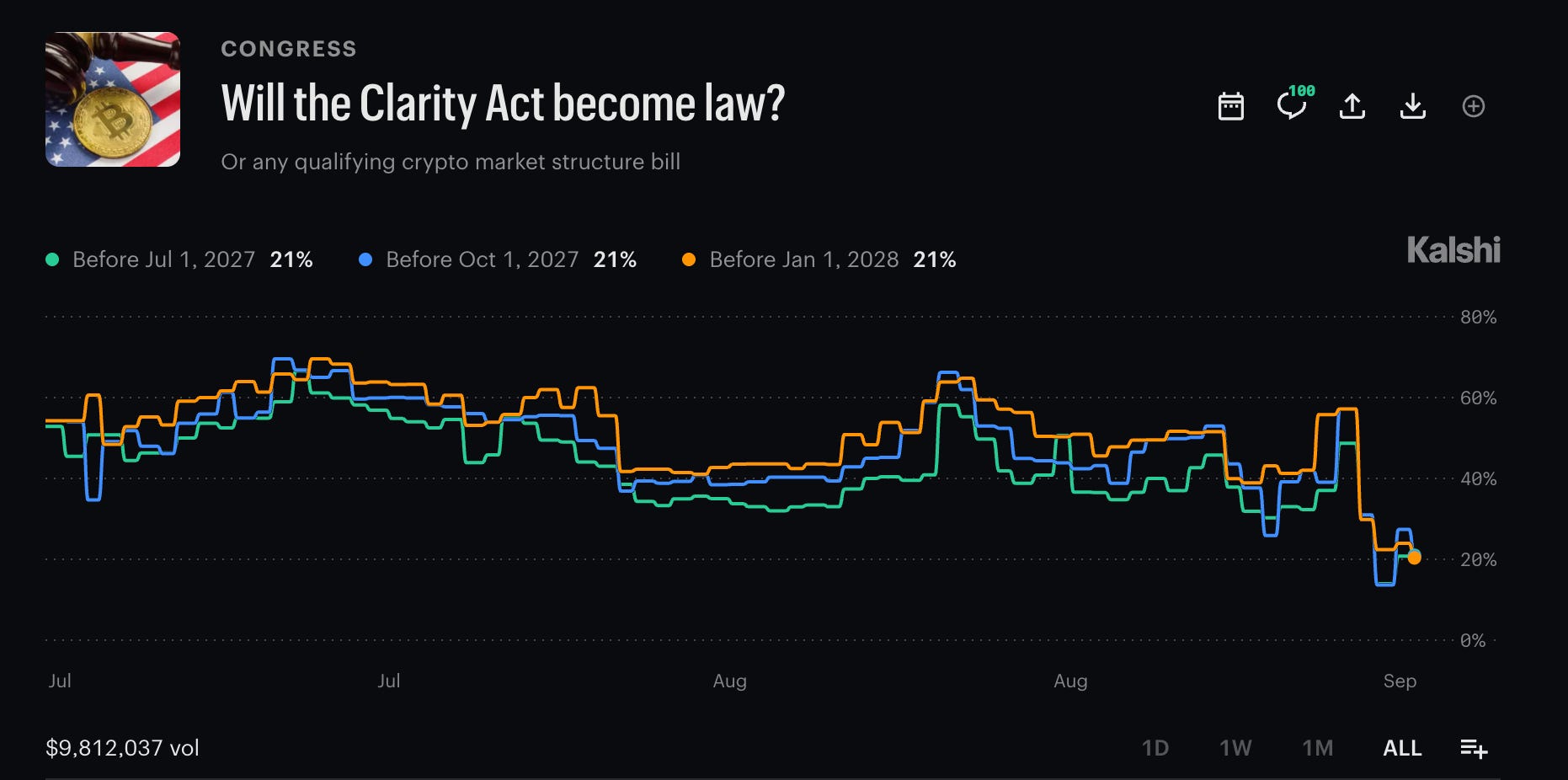
Prediction markets. Nowhere has the patchwork been more on display this year than in the fast-evolving world of prediction markets. The daily legal battle between prediction market operators like Kalshi and Polymarket and states looking to enforce regulatory jurisdiction over sports event contracts mirror the penchant for minute-to-minute entertainment which these markets are built on in the first place. In future years, this moment will be both venerated and studied in future MBA entrepreneurial courses and deeply panned in hard-hitting doc series. They will both ask the same question: What happened and how did it happen? The answer: regulatory, political and legislative uncertainty, a state-by-state arbitrage plan and a dream.
The American Gaming Association and the Indian Gaming Association, whose current members include brick-and-mortar regional operators and tribal gaming casinos respectively, have jointly pressed Congress to curb event contracts. The AGA put the states’ missed tax revenue from unregulated prediction markets at north of a billion dollars and has strongly aligned with the states, naming event contracts a direct threat to the regulated market. This move is not without strategy. While the Vegas strip continues to face questions of growing gaming, dining and overall hospitality and entertainment performance, regional casinos throughout the United States continue to carry the success of this vertical within the larger gaming industry.
The legal and regulatory battlefield has played out like a war movie, with different battles playing out on a wide array of theaters. In April the Third Circuit in New Jersey affirmed an injunction protecting Kalshi and just recently, the Ninth Circuit went the other way, holding unanimously that the substance of these contracts is sports gambling regardless of what Kalshi calls them, and that federal law likely does not preempt state gaming regulation. All of this as Washington failed last week to pass the CLARITY Act, which attempts to divide how the CFTC and SEC govern regulated digital assets but also could have far-reaching implications for controversial event contract types dealing with sports and politics.
All of this is on a fast (or slow) track to the Supreme Court — it depends on how you read the patchwork.
Data centers. Another prime example of this beautiful and organized chaos on display is in the meteoric rise and sudden descent of the political feasibility and popularity of data centers.
In roughly the first six weeks of the 2026 sessions, more than three hundred data center bills were filed across thirty-plus states, covering everything from outright bans to tax credit suspensions, siting reform, environmental regulation, power generation and labor and privacy standards. New York and Illinois, both huge data center markets in the past, required the executive rather than the legislative branch to act at all — Governor Hochul by executive order imposing a one-year moratorium on new hyperscale permits, and Governor Pritzker by directing his administration to pause new data center tax incentive agreements. Oklahoma’s megawatt cap died on the vine, and the recent water leak catastrophe in El Reno adds insult to injury within the policy sphere in the state.
As legislative action has stalled these last several months, and in the face of huge opposition from private investment and organized labor, and as political pressure grew from rural communities and angry constituents who have watched their electric bills rise through the roof, the regulatory action moved instead to the utility commissions and to local governments. In Illinois, leaders have incentivized alternative energy operators by passing huge pieces of legislation like the Clean and Reliable Grid Affordability Act, or CRGA, which aims to produce an additional 3 GW of energy storage capability by 2030 — the immediate goal being to sustain the growth of data centers and offset their impact. Following the adage of “all politics is local,” and as an example of the certainty that voters vote with their pocketbooks, the fights within these arenas have, for the most part, centered within affected local communities while state or official action slugs along.
Meanwhile, during all this time, the need for data centers has exploded with increased AI adoption among white-collar job markets and blue-collar task-doers alike, as did the electricity bill of all communities and especially the already vulnerable ones. With data center infrastructure growth set to reach $1 trillion by 2030, and the penchant for Washington not to touch hot-button issues and leave them to the states, this issue is a main bulwark of the patchwork.
Artificial intelligence. Like prediction markets, AI development and governance issues rest within the patchwork.
Recently, the daily news drip of AI models acting out within frontier in-house deployments points to the continuation of policy and governance debates throughout the 2027 and ’28 legislative sessions. Within these debates are key discussions of how to secure and stabilize the development of AI while also protecting and fostering growth and innovation.
While novel and revolutionary, AI continues to evolve daily — which makes it the ideal candidate for further study and, if I were placing a bet on Kalshi, I’d bet that their regulatory path would mirror the following pattern:
• New technology revolutionizes human behavior
• Wrongs and discomfort identified, press releases released
• Years of political posturing around multiple elections and campaigns
• Actual reform
As of midsummer, states have enacted something on the order of 109 AI laws across twenty-nine states. Meanwhile, Washington D.C. and the Trump administration have spent a year trying to preempt all of it. However, just this weekend, after a week filled with questions about the possibility of AI causing the apocalypse, Trump himself announced on Truth Social that he will create a new bureaucratic layer termed “AI Force,” headed by an “AI Czar.” So, the operative mindset for anyone deploying an AI product in the United States is: twenty-nine different rules, plus the live possibility that all of them get erased overnight.
Route gaming. They’re right in front of your eyes in gas stations, convenience stores and other retail establishments. Their purpose, regulation and legal protocols change from state to state, as do their revenue positioning and tax treatment — and you likely have no clue what to call them at all.
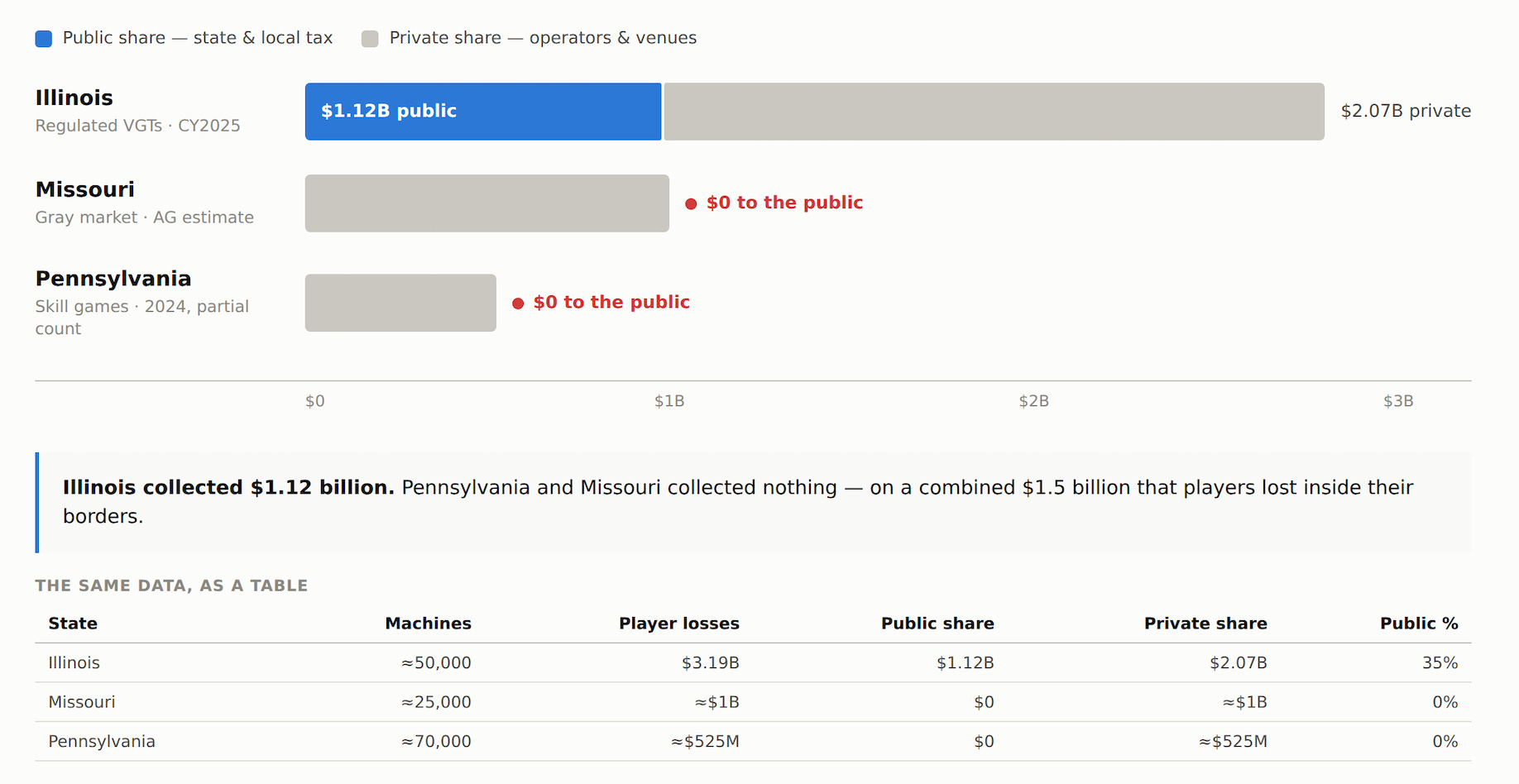
In Pennsylvania and Missouri, states with robust regional casinos, standalone machines that look like slot machines and pay like slot machines sat in bars, restaurants, stores and VFW halls for years while the courts argued about whether they were gambling devices at all.
This year served as a seismic shift on this front. In June, like a bolt of lightning from Zeus, the Pennsylvania Supreme Court held that skill games are slot machines and unlawful under the state’s gaming laws. The Court stayed enforcement for 120 days and started a clock, reminiscent of the doomsday clock, that runs out on October 13, at which point roughly seventy thousand machines go dark unless the legislature builds a framework which enhances gaming, provides for responsible gaming measures and ensures public benefit. Among the biggest opposition: the traditional casino gaming industry, who for years have enjoyed strong ROI and in recent months are investing heavily in new locations to help attract younger demographics.
Changing arenas to the “Show Me State,” with the absence of successful legislation, strong regional casino opposition, and as they watch Illinois prosper from legal and regulated VGTs, Missouri took the enforcement route this year. The timeline of events follows a familiar pattern of product expansion, regulatory arbitrage, legal battle and policy failure. A federal judge ruled the machines illegal in February, the attorney general persuaded the state’s largest operator, Torch Electronics, to unplug in April, and a Senate committee killed the legalization bill in May.
Meanwhile in Illinois, licensed VGTs have generated more than $5.7 billion in tax revenue for state capital projects since 2012, and in FY2025 video gaming passed the lottery — which had held the top spot since 2008 — to become the state’s largest single source of gaming tax revenue.
It’s worth mentioning that VGTs and VLTs are largely “Games of Chance,” more akin to casino slot machines and thus more accountable from a regulatory perspective. They require minimum payouts, are lab tested and participate in the tax revenue for the state — in Illinois, roughly 1.6% of the entire annual budget, and as of FY2025 the single largest source of gaming tax revenue in the state, ahead of the lottery, the casinos, sports wagering and horse racing.
The regulator in Illinois says it plainly. In the Illinois Gaming Board’s 2025 annual report, Administrator Marcus Fruchter writes that Illinois’ video gaming industry “is currently the largest source of gaming tax revenue” and that “the State’s regulated video gaming route network is the largest distributed network of its kind in the world.” Nearly 50,000 terminals across roughly 8,800 licensed establishments. That is the model for regulation in this sector, and it was built step by step with careful compliance and regulatory considerations along the way.
Dysfunction Is a Certainty
This fragmentation is not a bug in the American system; it’s the system itself, working exactly as designed, under conditions its framers never anticipated — or did they?
In performing this work, one must accept this and seek out the obstacle, learn it, be friends with it, take it to lunch, and ultimately turn it into an advantage. In taking this approach, anyone can crack this code and break the mold for their employers, shareholders, constituents, voters, etc.
Those that do this know which agency, working group, or stakeholder decides, as opposed to which one appears on the press release. They know a rule is being drafted eighteen months before it is a rule, because they know the drafting is downstream of a working group or influential caucus that met in February. They see where the through-points are, and more importantly, where they aren’t.
That skill has no name and no credential, and right now, it’s one of the highest-leverage capabilities a person could have, giving themselves and their clients strong agency and high likelihood of success in what is otherwise a puzzle of regulatory madness.
The Next Aristocracy
For the last twenty years, the key differentiator was attention. Capture it, aggregate it, resell it. That was the whole ballgame, and it produced enormous fortunes and an entire culture organized around the extraction of eyeballs. It also produced a captive generation of people who mistook engagement for insight and volume for value — drinking from a fire hose of content and putting their own creative fire on the back burner.
That era is closing by design, and the culprit is right in front of our eyes.
When generating content can be done in the blink of an eye, with very little skill, the market value of producing collapses on its face. We are seeing this in real time, through the sudden rise and fall of many engagement-native business pursuits, and it amounts to simple logic: abundance breeds mediocrity, and mediocrity kills price.
What does not collapse on its face is the value of knowing which claim or path is load-bearing and which is just window dressing.
For policy and regulation: which piece of politics and corresponding data controls the deal in front of you, and which conventional wisdom is the non-consequential status quo. Judgment, synthesis, and a map of the terrain get more valuable in a world of unfettered generation, not less, because they are the only remaining scarce inputs in a world filled with constant outputs.
So here is the bet this publication is making, stated as plainly as I can:
The next skill aristocracy will not be built on content generation, attention farming, or making money online. It will be built by the people who gather intelligence, analyze it, iterate on it, and collaborate with others to act on it before the regulatory and legislative window closes.
Information is the input. Knowledge is the advantage. First-moving is the output.
The richest available territory for that kind of work happens to be the exact gap I’ve been describing: the space between what a technology, product or industry can already do and what the rules currently permit. That space is enormous, it’s readable if you know where to look, and it’s fogged up with noise, negativity and 24-hour news cycles.
This space will write about the space in between. What the regulation is about to do to the industry and, more importantly, which industry advances have already made which regulation obsolete. That is the vantage point that is missing, and it’s the one that can help solve for this patchwork.
Where We’re Headed
Patchwork 50 publishes bi-weekly.
Each issue will take one piece of the bureaucratic albatross and draw it properly: a sector, a state fight, a definition worth a billion dollars, a gap that is about to close, or open. The through-line is always the same: here is what the thing does, here is what the rules currently allow, here is the distance between them, and here is how you can close it for yourself, your clients, your constituents, etc. Or, if you want to just impress your friends with all your random knowledge — that’s cool too!
I’m open to collaborative analysis too, opinion and POV takes on the topics I’m discussing, and others not brought up in this initial post or subsequent posts. After all, as we analyze, dissect and ultimately predict the future, one thing that we can take to the bank is that humans will need to collaborate and iterate and discover new channels, new movements and new outcomes together.
The gap between what our emerging technology and verticals can do and what our laws permit is the largest unexploited territory in the American economy. Almost nobody is charting it from a policy and regulatory perspective, and the people who do are going to gain the skill of catching a 90 MPH fastball and throwing it to second base in 1.9 seconds.
Let’s go find out where the seams are.
See you along the Patchwork!
Patchwork 50 is written by a 15-year government affairs and political professional. Reply to this email or write to hello@readpatchwork.com — I read everything.
Disclaimer
This publication and its authors are not licensed investment professionals, attorneys, or registered advisors of any kind to the readers of the Patchwork 50. Nothing published under the Patchwork 50 brand should be construed as investment, legal, or professional advice. Do your own research.