


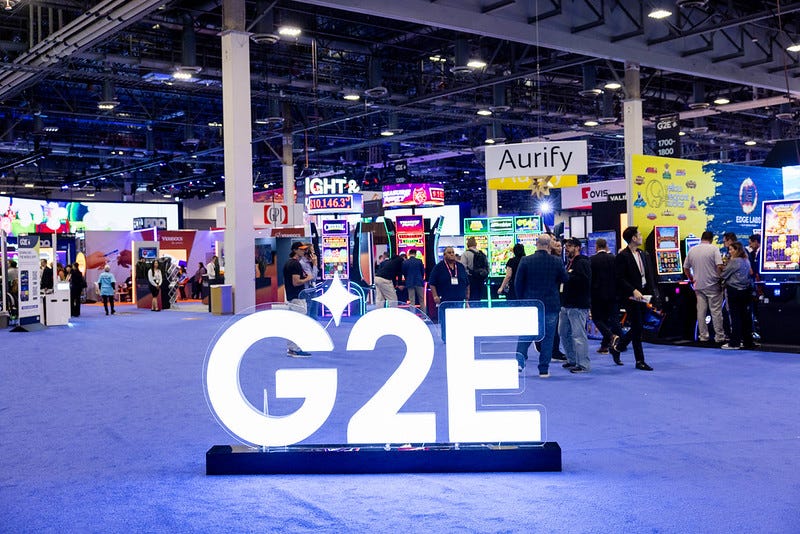
Source: Photo: G2E https://www.flickr.com/photos/136408179@N08/albums/
Chicago Bears and Philadelphia Eagles, MNF, and a rainy start to the G2E conference in Las Vegas.
While Case Keenum appeared to be in a “flow state,” going 24/34 for nearly 250 yards with 3 TDs, the Strip itself seemed to be in a flow state of its own. As Keenum, the veteran backup QB, took the field in place of injured “Madden” cover honoree Caleb Williams, the Strip was filled with rain from a burst of tropical moisture that swept into the Southwest last week.
Commuting to the site of the conference, G2E was especially interesting this year. Instead of avoiding tourists and street vendors and large transformer men, it was actual rain puddles that you had to avoid — quite strange for desert life!
Inside the conference, however, was anything but dry. It was wet hot — with sidebar conversations, event stage meetings and technology demonstrations all centered around the rapid rise and regulatory standoff between traditional gaming and startup prediction markets and the unmistakable imprint of AI technology integrations within regulated gaming.
Let’s take a deeper look!
Prediction Markets
It was hard to go anywhere last week at the tradeshow and not hear the words, “prediction markets” or “event contracts.” Indeed, the longstanding feud between traditional gaming interests and upstart quasi-gaming enterprises like Kalshi and Polymarket was on full display. Although these companies were not exhibiting or even present at the conference in an official capacity, their shadow loomed largely over the entire affair.
At issue: the basic question of who has regulatory authority over prediction markets — the states and their sports wagering laws or the federal CFTC?
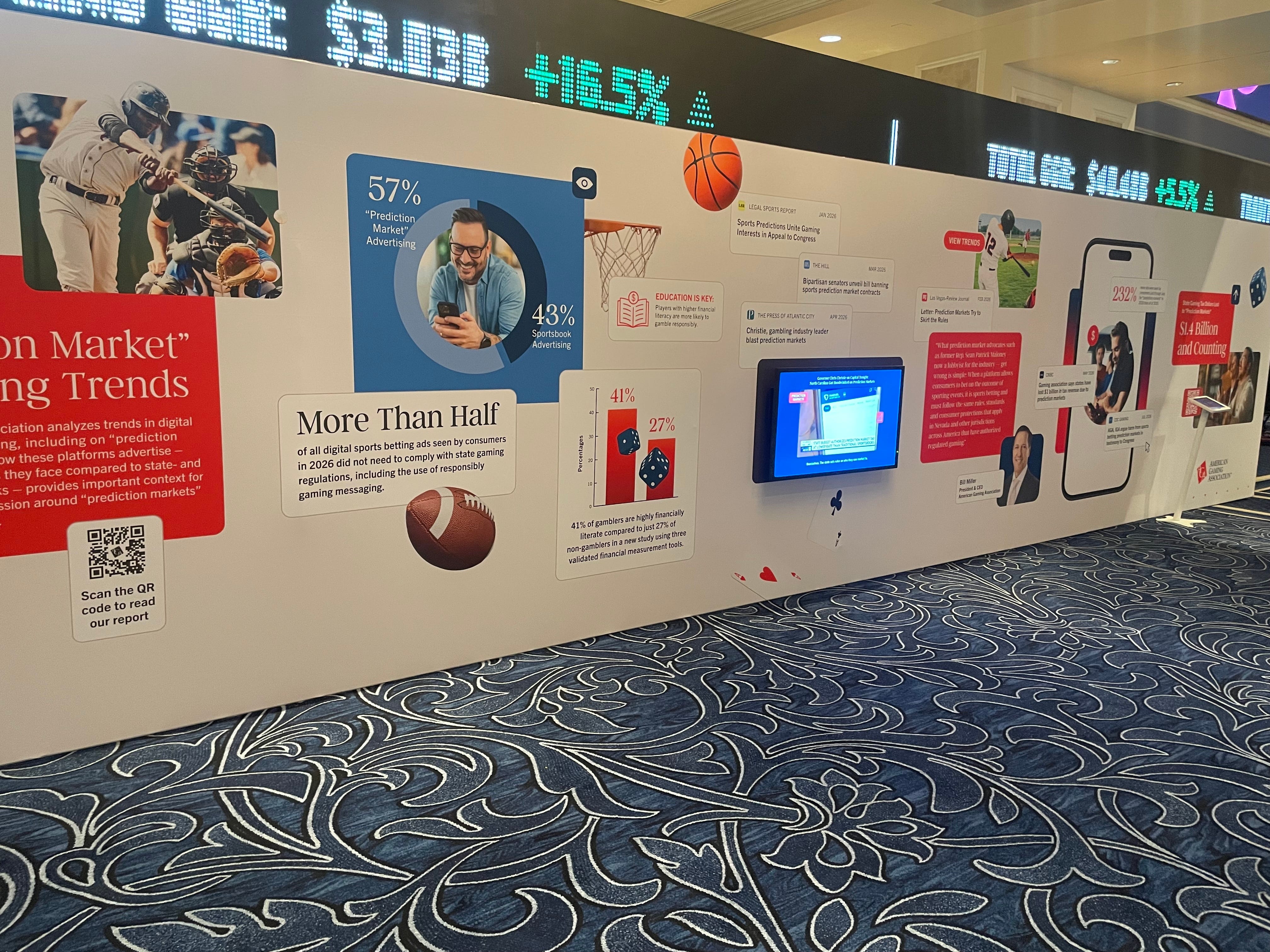
It was no secret where the AGA stood — displaying a prominent wall of education and advocacy on the subject, meant to outline all of the work they have been doing to curtail what they refer to as, “illegal gaming.”
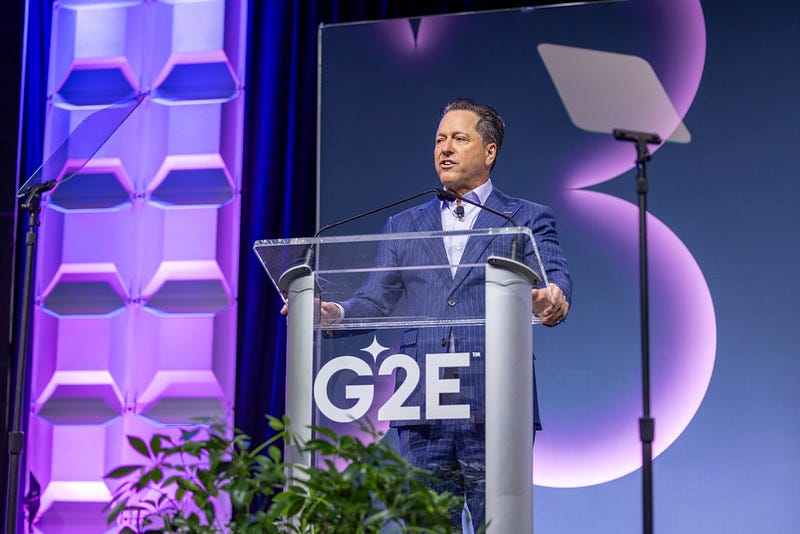
American Gaming Association President Bill Miller took the main stage at the Venetian Expo on Tuesday to sound the alarm on the accelerating threat of prediction markets. His message covered the argument in its entirety, with a clear nod to the alliance between the AGA and tribal gaming on the issue. Tribal gaming leaders had made their own case from the same stage a day earlier. On Monday, Indian Gaming Association Chairman David Bean and three other tribal leaders took the main stage for a panel moderated by IGA Executive Director Jason Giles, who noted that states have prevailed in 38 of 43 court decisions against prediction markets.
“They call themselves prediction markets. And their message to states and tribes seems pretty straightforward. Your laws don’t matter. Your regulations don’t matter. The tax structures don’t matter. Your sovereignty doesn’t matter.” – AGA President and CEO Bill Miller
“These are basically untaxed, unregulated, consumer-predatory organizations that are masquerading themselves as investment vehicles,” David Bean, chairman of the Indian Gaming Association (IGA), said of prediction market companies.
Source: Photo: G2E https://www.flickr.com/photos/136408179@N08/albums/
During the show and adding to the drama, some major news also broke concerning prediction markets, which is completely on brand for them.
CBS News announced a formal partnership with Kalshi for the midterm elections, showing that the 2024 presidential election and the prediction market revolution that occurred within it, have real public efficacy and staying power. Kalshi also has a similar agreement with other major news outlets including CNN.
Election markets have existed for decades — Iowa Electronic Markets ran academically for years, and prediction markets have been cited in election coverage without visible harm. What’s new is scale, retail access, and a broadcaster with an editorial interest in the number it reports.
The tie in here is the angle of regulatory overlap, wrapped in more regulatory overlap. The CFTC currently maintains that they oversee these contracts over state regulators, the FEC oversees campaign money, the FCC oversees media networks, state election officials oversee the ballot, and nobody technically oversees an individual broadcaster reporting odds on a race while a market maker profits from volume. That gap is the most Patchwork-50-shaped development to come about the last two weeks; a national product, fifty state election codes, and no one holding the question.
AI Integration
If prediction markets were the ghost haunting G2E, AI was the angel and devil on its shoulders.
Walk the floor at the Venetian Expo and nearly every booth had found a way to fit those two letters onto its signage. But no company made the point more bluntly than BetConstruct AI, one of the most visible names at this year’s show.

Source: Yogonet - https://www.yogonet.com/international/news/2024/02/14/70805-betconstruct-launches-new-range-of-products-to-drive-player-engagement-and-partner-efficiency
If you want to launch an online sportsbook or casino but don’t want to build one from scratch, BetConstruct will rent you the whole thing — the betting engine, the odds, the casino games, the player accounts, the back office, and put your logo on the front. The industry calls this a “turnkey” or B2B platform. Your customers never see BetConstruct’s name; they see yours. The company is licensed out of Malta and the U.K., and says more than 500 operators use its AI products.
The AI sits on top of that plumbing by incorporating such features as a chat assistant, recommendation engine and various other “bet engagement tools.”
BetConstruct’s own pitch for all of it: a “proven increase in turnover.” That’s the business case for AI in gaming in four words. And to be fair, it isn’t a scandalous one. Every retailer in America runs a recommendation engine. But “you might also like” lands differently when the product is a wager that you can potentially win, than a random friend request or follow on social media.
Which brings us to the elephant in the G2E room.
On October 1st, the same day G2E closed its doors, a West Virginia bettor filed a proposed class action in federal court in Boston alleging that DraftKings “weaponized AI” to “understand and exploit users’ vulnerabilities.” The complaint says the company used AI to identify customers likely to keep betting through their losses and then hit them with personalized promotions; the named plaintiff says he received roughly 70 promotional emails, texts, and messages in a single month. It cites former employees describing systems built to re-engage users who were trying to leave, claims the analytics lifted promotional margins 13% in 2025, and argues DraftKings ran afoul of Massachusetts rules governing how sportsbooks may use AI.
DraftKings flatly denies the allegation: “DraftKings does not use AI to target customers based on losses, nor do we use AI to target customers based on indicators of potential problem gaming.”
What makes this a Patchwork story is who was already paying attention. A week before the suit, after a New York Times investigation into DraftKings’ AI-driven promotions, Massachusetts Gaming Commission Chair Jordan Maynard directed staff to engage with DraftKings and said the commission would review how all of its operators use AI. Once the suit landed, the Massachusetts Attorney General’s office said the allegations “raise serious concerns about the potential use of technology to target or exploit consumers.”
To recap, a state gaming regulator is now asking a question about artificial intelligence that almost no gaming law in the country was written to answer. Massachusetts is the rare exception: its sports wagering rules bar operators from using any “machine learning, artificial intelligence, or similar system” reasonably expected “to make the gaming platform more addictive,” and one commissioner noted Massachusetts may be the only state with AI in its gaming regulations at all. Who governs the algorithm: the gaming commission that licensed the operator, the attorney general enforcing consumer protection, or a state AI law not explicitly written for the gaming industry? Expect fifty different answers and expect them to arrive one lawsuit at a time.
I’m not here to tell you AI personalization is inherently predatory nor am I linking BetConstruct AI with these developments. The question isn’t whether, it’s where the line on gaming AI integration sits, and who gets to draw it.
A New Trend Emerges
Here’s the story that got less stage time at G2E than it deserved, and it may outlast everything else in this issue.
In May, the National Council on Problem Gambling — the national nonprofit that state regulators, operators, and treatment providers all lean on for responsible-gambling standards, training, and referrals, made Kalshi the first member of a brand-new “Financial Services & Trading” membership category. Kalshi pledged $2 million over two years for what was billed as trader health and safety work.
You can guess how that landed with members whose states were, at that very moment, fighting Kalshi in court. The exits from the umbrella organization came in succession: the Ohio Casino Control Commission (June 26), the Michigan Gaming Control Board (July), and the Nevada Council on Problem Gambling (August, after its request to pause its membership was denied). On September 10, the Massachusetts Gaming Commission said its membership may no longer reflect the commission’s values.
Then the staff started leaving. NCPG’s Director of Programs, Jaime Costello, resigned, saying “the environment shifted in ways I could no longer reconcile with how I believe this work should be done.” A week later, on September 28, Executive Director Heather Maurer announced her own resignation, effective October 16, less than a year into the job.
The honest caveat: a resignation amid a controversy is not necessarily a resignation because of one, and Maurer hasn’t said otherwise. But consider that NCPG’s board president now describes prediction markets as “functionally gambling” — the same organization that, four months earlier, built a special membership category so one of them could join. Whatever the cause, the donation became a fracture point for the leadership and its partner organizations.
Responsible gambling infrastructure is quasi-public. States write NCPG resources into their rules and helplines without funding the organization themselves. When that body’s independence is in question, states lose a dependency they never controlled and didn’t budget for. And this is the second shock in about a year: NCPG lost the rights to the 1-800-GAMBLER hotline in September 2025 and had to rebuild around a new number, 1-800-MY-RESET. This all wrapped around the fact that calls to those very helplines continue to climb as more and more platforms for consumers to gamble become available both online and offline. New York’s HOPEline took 8.5% more calls in 2025 than in 2020 as mobile sports wagering surged. In Massachusetts, the same state where DraftKings now faces the AI lawsuit, calls to the problem gambling helpline more than doubled (up 121%) in the year online sports betting launched.
A state regulator has three tools to reach for: licensing, taxation, and responsible gaming. Prediction markets are contesting the first two in federal court right now. Whether by design or by accident, they’ve now destabilized the third. A state’s self-exclusion list doesn’t reach a platform it doesn’t license, and the national body it would normally consult seems to be coming apart at the seams.
So, what fills the gap? My bet (no pun intended), the states do it themselves. Watch the 2027 sessions for line items and rulemakings that bring in-house the RG standards, training, and helpline functions that used to be outsourced to a single national reference point. One framework becomes fifty. That’s the patchwork being stitched in real time, and it’s the least-covered second-order effect of the entire prediction-market fight, landing on exactly the institutions a regulator would reach for first.
Who Lives, Who Dies, Who Survives?
Let’s zoom out. Where does all of this stand and eventually, land?
Start with what operators are doing, not what their lawyers are saying. In September alone, the field split at least three ways:
Litigate. Underdog sued five states: Ohio, Massachusetts, Wisconsin, New Mexico, and Washington — arguing that federal law gives the CFTC exclusive jurisdiction and state gaming laws can’t touch its contracts. Days earlier, it surrendered its daily fantasy licenses in seven states. Those aren’t two strategies; CEO Jeremy Levine tied them together, saying those states had “taken the legal viewpoint we disagree with.” Underdog is betting the company on preemption, and a strong federal government. Kalshi, meanwhile, lost at the Ninth Circuit in August and is asking the full court to rehear the case, while Supreme Court petitions from New Jersey, Robinhood, and Crypto.com are still pending.
Withdraw. Robinhood cut a court-approved deal with Michigan on September 10 to pull sports event contracts and close open positions within 30 days, without conceding the legal question. Kalshi didn’t get a deal; it was ordered out of Michigan sports by injunction. And for football season, prediction markets are live in most of the country but not in Nevada, where the state won its own injunction, or in Washington, where state courts have also moved to enforce.
Sell umbrellas, pray for sun. The licensed incumbents are running prediction-market products of their own. Among them is FanDuel Predicts, even as FanDuel’s parent, Flutter, is quietly — or loudly, depending on who you ask — rooting for the whole category to be shut down. Flutter’s CFO told a J.P. Morgan investor conference that regulatory clarity would be preferable to the current uncertainty, and the bank’s analysts read a shutdown as the more positive near-term scenario. DraftKings CEO Jason Robins was blunter: “If prediction markets got shut down by the Supreme Court tomorrow, our share price would pop.” Add Chris Christie, the godfather of legal sports betting and current adviser to the American Gaming Association, urging state attorneys general in late September to send cease-and-desist orders to Kalshi and Polymarket.
Different postures may reflect different exposure rather than different predictions. Robinhood holds broker-dealer registrations a pure exchange doesn’t, so it has more to lose from an adverse state finding and would retreat earlier no matter what it expects. This is risk-tolerance 101 and not a crystal ball into the future.
With that caveat, here’s how I see it shaking out.
Who survives: the companies with optionality, and this is obvious. The licensed sportsbooks that run both a regulated book and a prediction-market product win under either outcome: if the Supreme Court sides with the states, they keep the licensed business and fold the rest; if it sides with the CFTC, they already have a product in market. Hedging looks cowardly in a press release. It looks brilliant in a 10-K.
Who dies: the single-thesis players. Anyone who burned their state licenses to go all-in on preemption has removed their own fallback. If the Ninth Circuit’s view prevails, the state map becomes the permanent map, and companies that walked away from it will have to ask to be let back in — by the same regulators they sued and actively fought.
Who lives — but changes: the states and the institutions behind them. Even a clean win at the Supreme Court for upstart stakeholders doesn’t restore the responsible-gambling backbone that fractured this summer, nor does it discount the opportunity for new taxation. States will rebuild RG initiatives locally and enact new ways to tax and regulate these new products. Indeed, they already have begun to do so: Illinois routed its new tax through sports event contracts, North Carolina now taxes prediction-market operators at 6% of net trading-fee revenue, and Kentucky enacted a 14.25% tax on operators, now under legal challenge from a coalition that includes Kalshi and Polymarket.
Re-enter AI. Preemption is a fight over who gets to call these products gambling. It doesn’t settle who gets to police how they’re sold. The DraftKings complaint rests on contract claims and a Massachusetts gaming rule, with the state’s consumer-protection statute held in reserve, and that’s terrain the CFTC preemption argument was never built to cover. Whoever wins the jurisdiction fight, the AI-personalization fight is headed to state attorneys general, state gaming commissions, and state legislatures, at precisely the moment the national RG infrastructure those regulators would lean on is at its weakest. Prediction markets accelerated the product. AI is accelerating the pitch. The rulebook for both is about to be written fifty times.
The best forward indicator in all of this isn’t a ruling, it’s where operators pull out, which you can observe without waiting on a court.
A map of which contracts are live in which states, updated weekly, would be the single most useful artifact in this domain.
Nobody publishes one — yet.
Stay tuned and continue to follow, the Patchwork.
Patchwork 50 is written by a 15-year government affairs and political professional. Reply to this email or write to hello@readpatchwork.com — I read everything.
Disclaimer
This publication and its authors are not licensed investment professionals, attorneys, or registered advisors of any kind to the readers of the Patchwork 50. Nothing published under the Patchwork 50 brand should be construed as investment, legal, or professional advice. Do your own research.