


The 2026 midterms are complete, and with them, Republican control of Washington. Democrats won both chambers of Congress and, for the first time in 16 years, a majority of the nation’s governorships.
In haste of being too overtly political I’ll reserve my fire on the total dumpster fire that became of the House and Senate Republican majorities these midterms and instead focus on where most things truly matter — the states and what the national sea change means for some of the most highly regulated and under-regulated industries we’ve discussed thus far, and more.
Let’s dive in.
The vote vs. the week after
The week after the election is when the pulse of the Country is truly absorbed and understood in a more profound way than on election night. This is anecdotal, of course. Yet it bears repeating to underscore just how profound an about-face the country’s electorate made in this contest and how many affiliated groups, stakeholders and culturally salient entities feel about it.
I’ll spare you the finite numbers, the updates on outstanding races and the breakdown of germane swing-state Townships and dive right into what these results mean for the industries we care about; the disrupters, the incentive-trackers, the builders and the technologists.
All things considered, I would say that the results last Tuesday were good for governing on the state-level — which in-turn is good for incentivized programs, regulatory debates and expanding legislation which largely will bring clarity and predictability to hugely profitable and expanding emerging markets.
For purposes of the Patchwork, this election was surprisingly and assuredly clarifying in that a shift to a governing-first approach is on the horizon with the hopes of clearing haziness, gamesmanship and negativity around some of the most meaningful technology developments of our time — and we needed it, now more than ever.
In short summation: the states came out on top and the feds are living to fight another day. Let’s track where I’m coming from.
On the ballot: Land-based and sports betting
It was a night for voters to decide about land-based casino expansion and iGaming expansion, and decide did they..
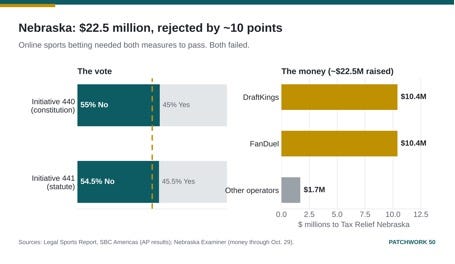
DraftKings and FanDuel put a combined $20.8 million ($10.4 million each) into Tax Relief Nebraska, the committee behind the state’s two online sports betting initiatives, and it made no difference as Nebraska voters soundly rejected both measures, 55-45 and 54.5-45.5, to expand gaming in the Cornhusker state.
Meanwhile in Texas, the governor’s office has officially turned blue with the victory of Governor-elect Gina Hinojosa and defeat of three-term governor Greg Abbott. This dramatic change has far-reaching effects for gaming in the nation’s second-most-populous state and its largest untapped market outside California. The State leadership has been steadfast in gambling opposition for the last several years, led in opposition by Lieutenant Governor Dan Patrick, who wielded quite a bit of outside influence in the discussion and is also now not going to be sitting in his office come January 19. Democrat Vikki Goodwin beat him, and Democrats flipped the Texas House, though the Senate he presided over keeps a smaller Republican majority.
During the last years Texas has been considered as the next stop on the gaming brick-and-mortar expansion with plans to build a casino in the state. So far plans have failed but now, PENN CEO, Jay Snowden sees quite the opposite.
On the company’s Nov. 5 earnings call, Snowden pointed to Penn’s two Texas racetracks, Sam Houston Race Park and Retama Park: “We’ve got two great assets there and we’re ready to play offense.”
Back in the Midwest, we see that all three northeast Indiana casino referendums were rejected and the interactive and traditional brick-and-mortar industry is feeling way more confident about Ohio iGaming expansion.
Voters said no in all three counties: about 65% in DeKalb, 59% in Allen and 58% in Steuben. Under the law, none of them can hold the vote again, and no major casino developer had stepped up to bid.
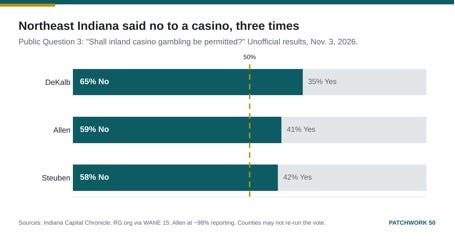
Indiana, which already takes in $2.44 billion a year in casino win (fiscal 2026) from 13 commercial casinos, was looking to add one new license in Allen, DeKalb or Steuben County. As seen many times in gambling-related referendums at both the state and local levels, these questions usually fail despite the anticipated mood of the voters on the subject at hand.
In the buckeye state, Governor-elect Amy Acton has said she’s open to regulated online casinos, with protections for young people and limits on predatory advertising — which is why the industry rejoiced upon learning about Ramaswamy’s defeat. Amy Acton represents looking at the issue with new vision and fresh eyes in a state that’s already been burned by an awful lottery sports betting kiosk rollout; its largest vendor took 93% of kiosk locations offline in 2025.
What will happen next is anyone’s guess. However, I’m confident in saying that the legal and regulated market has a chance. As for the unregulated and under-regulated side of things: we do not yet have fully sufficient data in a number of key states and within a number of key issues.
Online casinos and skill games: the governors hold the pens
One key feature of last week was the resounding fact that governors now hold the decision-making capability on many very important open questions in the gaming space and beyond. At least 28 states will have Democratic governors in 2027, the party’s first majority of governorships in 16 years. What this means for online casinos and skill/gray games could point to clearly-defined goals and established stakeholders within these verticals and a more-defined emphasis on responsible gambling.
As we discussed in a previous issue, retail establishments in Pennsylvania have been without a source of revenue or a viable vehicle for legislative action since October 14th. The costs of that inaction are already showing their effects. On Oct. 16, Pittsburgh’s WPXI reported that establishments are utilizing their leverage and firing one of the few arrows they have in this fight themselves, the boycott of PA lottery sales.

This development is uniquely interesting because lottery sales bolster state finances in a way that the skill games could also do, drawing attention to the fight to potentially license and legalize these games once and for all, or use them to expand the state’s VGT network in truck stops and travel centers. Will the boycott and vocal efforts of the skill lobby be enough for Governor Shapiro to move his pen? Will he look at a state like Illinois, headed by fellow potential presidential candidate JB Pritzker and learn from his shepherding of a legal, regulated network of VGTs with emphasis on safety and accountability? Time will tell…
In the interactive segment, the elephant in the room, which has since been eaten by prediction markets is still online sweepstakes games. In my view these games are unlicensed gambling dressed up as sweepstakes, and a growing list of states, Indiana among them this year, has banned them outright. Their owners argue that no real money is exchanged but when you dig deeper, does it really matter? These website look, act and feel like regulated sites like DraftKings, BetRivers and BetMGM, but they are not. They’re offshore (oftentimes) lack meaningful advertising standards or RG programs and generally pay no state gaming tax. Unlike prediction markets they do not have the CFTC backing their legitimacy. Tuesday night put their continued demise in the hands of governors who are keenly aware of the harms of unregulated gambling and looking for a scapegoat in the absence of making fatal blows to prediction markets. In Arizona, VGW, a well-known sweeps company, kept operating for nearly two years after a private state cease-and-desist order and spent about $360,000 on political groups in both parties this cycle, including groups backing Governor Hobbs, who won re-election. How’s that for chutzpah?
What does this mean? It means that both land-based and online-based unregulated gaming is not going to advance. In Pennsylvania, I believe that skill games will be brought under a sizable and comparative tax structure in the state and commit to adhering to the state’s commitment to responsible gaming, especially because the state helpline logged a record number of calls in 2025 (more than 2,700 through November alone) and intake calls climbed 40% between 2021 and 2025. If skills refuse to comply and dig deeper, they run the risk of rendering themselves completely null and void and pushed to the side in favor of regulated and responsible VGTs.
Same story on online sweepstakes. Those operators that can adapt to these standards, will. Those that cannot or won’t will continue to face defeats and lawsuits and the more they pile up, the less favorable the business plan looks entirely. The far more likely scenario for online gambling exists within the regulated space, as operators within this space are far more likely to adopt and implement problem gambling initiatives, which increasing states are focusing on due fragmentation at the national level infrastructure.
Energy: siting, data centers & storage
We have hardly touched on energy yet within the Patchwork. In part because to my mind, it’s the most important element of the patchwork that exists, and unfortunately, also the least moving. The lack of content on these issues is not an oversight, it’s an attempt to make sure we get it right.
What the midterms tell us with regard to energy is that the 2027 siting fight is set by electricity costs and municipal votes, not by who won statehouses.
Data centers lost almost everywhere they were on the ballot. Ballotpedia counted 41 measures, voters in 10 states approved nearly every local data center restriction, and Ohio accounted for 21 of them, more than half the national total. In 40 of the 41, a majority favored greater limits, either by passing a restriction or by rejecting a measure that would have allowed or endorsed a project. These weren’t close.
Then it went statewide. As we have heard elsewhere in this piece, Democrats flipped the governor’s offices in Texas, Ohio and Georgia, and all three winners campaigned on pausing or reining in the data centers that many voters blame for rising electricity costs. Georgia’s governor-elect has said she’ll sign an executive order imposing a temporary moratorium on new data center approvals, a pause that could last from a month to six months or longer. Wall Street read it the same way: AI data center stocks fell as the results came in.
What’s interesting about this? In this year’s legislative sessions the restrictive side lost. Most restrictive siting bills proposed in 2026 didn’t even make it out of initial hearings, while permissive reform won in Illinois, Oregon, Virginia and Washington. Opponents who couldn’t get a bill out of committee went to their respective local officials and utility lobbyists instead, and won. Statehouse trackers recorded a win for building. The ballot recorded the opposite.
The money explains the anger. U.S. electricity prices are up roughly 10% since early 2024, and Goldman Sachs analysts expect data center demand to keep pushing them up faster than overall inflation. A noise complaint reaches the people next door. A rate case reaches everyone who pays a utility bill, and so on..
The new governors have real tools, but they don’t reach everything and everyone. States can pause data centers, choose who regulates utilities and end the tax breaks that drew many of these projects in the first place. What they can’t do quickly is lower a bill set by wholesale markets. Watch the utility commissions, not the press releases.
The energy fight moved down a level. Bills in the capitol, tariffs at the commission, bans at the county. If you’re only watching the legislature, you’re watching the slowest part of it.
Off the ballot: EV Charging & prediction markets
Shifting gears slightly and combining both EV charging and prediction markets; two of the most important themes of the patchwork, we can make the calculation that these two items are the most consequential items not actually voted explicitly on within the elections. Despite their largely federal purview now, the states can determine their course in a way that they previously have not been able to within the Trump presidency.
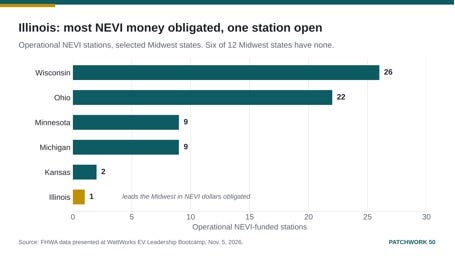
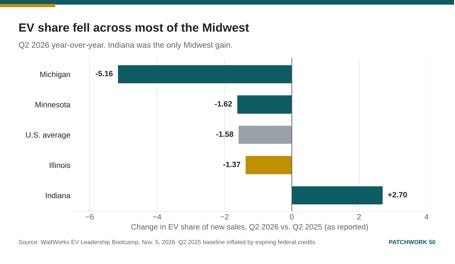
EV charging. EV charging is the quietest piece and has the hardest deadline. Federal surface transportation programs run through December 11 without the advance funding that paid for NEVI. Earlier this year Congress rescinded nearly $504 million in NEVI funding from 28 states, though states still have access to about $4 billion for EV charging. Illinois shows the gap between money and concrete. It leads the Midwest in NEVI dollars obligated and has one operational station. What keeps charging alive in states like Illinois isn’t the statehouse. It’s utility commissions enforcing plans that state law already required utilities to file. A prime leader of this example is Ameren and ComEd who both deploy strong EV readiness programs and work directly with contractors, small businesses and other consultants to energize sites, provide rebates and make sites available for EV Charging. Will the Democrats in Congress ensure this continued coordination through additional EV charging dollars, or will they pick their battles? If this election is any indication, democrats clearly have it in for some purse-string payback.
Prediction markets. Although not technically on the ballot, somewhere in the back of voters minds laid the burgeoning prediction market industry. The rise of these markets and the companies who operate them have been hard to miss the last year or two — and this election was America’s first chance to weigh in on their legitimacy.
Harkening back to the beginning of this article, I think what actually happened since the election was far more novel and interesting than anything that happened within, as it relates to this disruptive industry.
On Nov. 5, the CFTC gave a 30-day notice to all operators to stop geofencing. You heard that right. The CFTC told the likes of Kalshi and Polymarket, etc to stop geofencing their product, or explain why they can’t, out of states that jurisdictional enforcement per open lawsuits, etc. That is one hell of a flex just days after a weakening of Republican and presidential power and it means everything to this story.
I have long maintained that the less politically popular the Trump administration becomes the more aggressive the CFTC will be in their regulatory approach in an attempt to assert and affirm lasting control on this sector. We saw that theory proved this week.

Adding intrigue to the whole development is the fact that sports event contracts completely dwarfed election event contracts volume this midterm — showing with hard and digestible data that these are sports betting companies through and through.

The central takeaway from the November 4, 2026 Legal Sports Report article is that sports betting activity overwhelmingly dominates prediction markets—even during a major U.S. election.
So let’s get this straight. Sports betting is regulated on the state level by state jurisdictions. Kalshi’s trading volume is overwhelmingly sports: over the 10 days around the vote, it traded $25.3 billion in parlays against $1.1 billion on elections and the CFTC chair announces for Kalshi and others to stop geofencing away from the jurisdictional state purview. This is wrapped in the patchwork and the next two years will define how we move forward in congress and the states.
What comes next?
So, where does this leave us?
It leaves us with a bucket of popcorn, a computer and two years of Congressional posturing and state action.
Election night picked who holds the pen. The calendar decides what they get to write, and most of it is set by people who weren’t on the ballot. We’re tracking every date here:
https://tinyurl.com/GovAtlas-Tracker
Dates move. If you see one change before we do, tell us.
Patchwork 50 is written by a 15-year government affairs and political professional. Reply to this email or write to hello@readpatchwork.com — I read everything.
Disclosure: the author works in the gaming industry, including for an operator mentioned in this issue, and advises clients in EV charging. Views are the author’s own.
Disclaimer
This publication and its authors are not licensed investment professionals, attorneys, or registered advisors of any kind to the readers of the Patchwork 50. Nothing published under the Patchwork 50 brand should be construed as investment, legal, or professional advice. Do your own research.